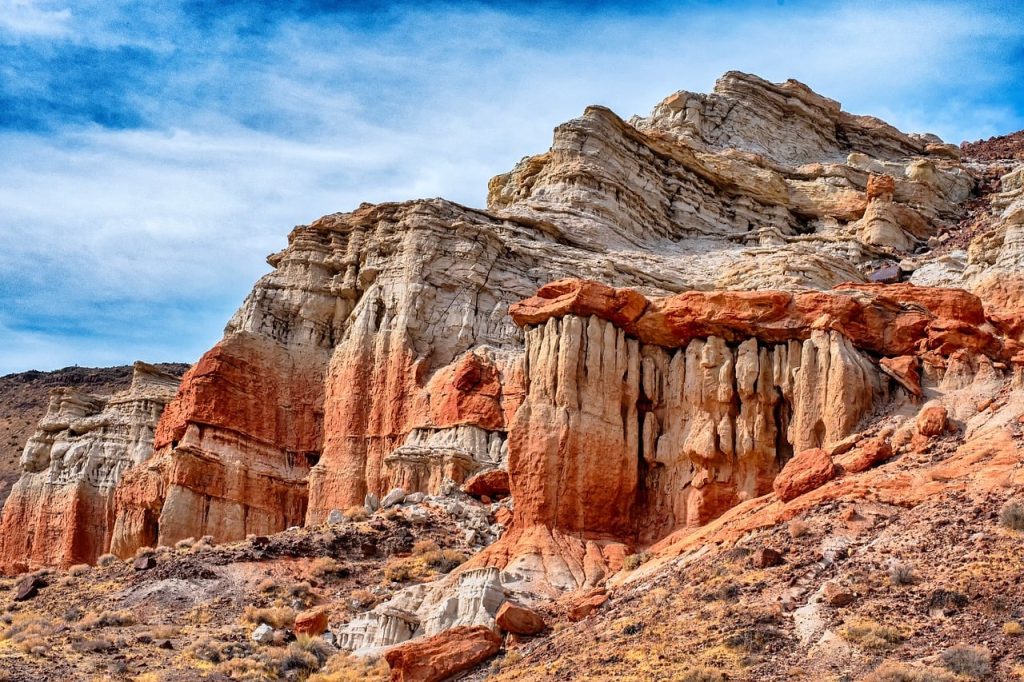
Introduction:
Have you ever asked yourself, why and how mountains are form? do Why earthquakes happen? Where are important minerals found? Geology has the answers to these questions. It is one of the most important Earth sciences because it allows us to understand the world we live on, its history, its resources, and the ongoing natural processes that shape it.
Geology is the science of the structure and evolution of the Earth, from the rocks beneath our feet to the continents and oceans that shape our planet. It is also important for engineering, disaster preparedness, resource management, and environmental preservation.
This extensive overview of geology, including its definition, significance, main subfields, and career options, is given in this page.
What is Geology?
Geology is the scientific study of the composition, structure, history, and processes that make up the earth. The word ” geology ” comes from two Greek words : geo meaning ” Earth ” and logos meaning ” study ” .
Geologists study rocks, minerals, fossils, landforms, underground water and geological processes to learn about how the Earth has changed over billions of years. They also look at things that keep changing the world, such as plate tectonics, erosion, earthquakes and volcanic activity.
In simple terms, geology helps us answer three fundamental questions:
- What is the Earth made of?
- How did the Earth form and evolve?
- What processes continue to shape the Earth today?
Historical Development of Geology
While people have studied rocks and minerals for thousands of years, geology was not a formal science until the seventeenth and nineteenth centuries.
James Hutton, one of the most important geologists, is often called the “Father of Modern Geology.” He developed the theory of uniformitarianism that geological processes of the present are similar to those of the past.
These ideas were developed further by scientists such as Charles Lyell, who was instrumental in establishing geology as a scientific discipline . Their work has laid the foundation for our current understanding of Earth’s history and geological processes.
Why is Geology Important?
Nearly every aspect of human existence is impacted by the science of geology. Societies can manage resources, safeguard the environment, and lessen the effects of natural disasters by having a better understanding of geological processes.
1. Natural Resource Exploration
A lot of essential resources originate from geological processes, and these include:
- Metallic minerals such as iron, copper, and gold
- Industrial minerals used in manufacturing
- Coal, petroleum, and natural gas
- Groundwater resources
- Construction materials such as limestone and granite
Geologists help locate, evaluate, and manage these resources sustainably.
2. Understanding the History of Earth
Fossils and rocks are records of Earth’s past. Geologists may reconstruct ancient habitats, temperature shifts, and the evolution of life across billions of years by analysing these records.
Scientists can better comprehend how the Earth has changed and how it might change in the future thanks to this knowledge.
3. Natural Hazard Assessment
Geological studies improve our understanding of natural hazards, including:
- Earthquakes
- Volcanic eruptions
- Landslides
- Coastal erosion
- Flooding related to geological factors
This information helps governments and communities develop strategies to reduce risks and protect lives.
4. Environmental Protection
Geologists contribute significantly to environmental management through:
- Monitoring groundwater quality
- Assessing pollution impacts
- Investigating soil contamination
- Studying climate records preserved in rocks and sediments
- Supporting sustainable land-use planning
5. Engineering and Construction
Geological studies are frequently necessary before roads, bridges, dams, tunnels, and buildings are built in order to ascertain whether the ground can sustain the project safely.
Engineering geologists assist in identifying possible hazards and suggest appropriate building techniques.
Major Branches of Geology
Geology is a broad field with several specialized branches.
Physical Geology
The materials of Earth and the processes that sculpt its surface and interior are the main topics of physical geology. It looks at things like volcanism, weathering, erosion, and earthquakes.
Historical Geology
By examining rocks and fossils, historical geology researches Earth’s past. It aims to comprehend how climates, continents, oceans, and living things have evolved over time.
Mineralogy
The study of minerals, including their content, characteristics, formation, and categorisation, is known as mineralogy.
Petrology
Petrology focuses on the origin, composition, and classification of rocks.
Structural Geology
Structural geology examines the deformation of rocks caused by tectonic forces, including folds, faults, and fractures.
Paleontology
Paleontology studies fossils to understand ancient life forms and evolutionary history.
Hydrogeology
Hydrogeology investigates ground-water occurrence, movement, and quality.
Environmental Geology
Environmental geology applies geological knowledge to solve environmental problems and support sustainable development.
The Three Main Types of Rocks
The solid components that make up the Earth’s crust are called rocks. Based on how they form, they are divided into three main types.
Igneous Rocks
Igneous rocks form when molten rock material cools and solidifies.
Examples include:
- Granite
- Basalt
- Diorite
These rocks may form beneath the Earth’s surface or after volcanic eruptions.
Sedimentary Rocks
Sedimentary rocks develop from sediments that accumulate, compact, and become cemented over time.
Examples include:
- Sandstone
- Limestone
- Shale
These rocks often contain fossils and provide valuable records of Earth’s history.
Metamorphic Rocks
Metamorphic rocks form when existing rocks are altered by heat, pressure, or chemically active fluids without completely melting.
Examples include:
- Marble
- Slate
- Schist
- Gneiss
Minerals and Their Importance
A mineral is a naturally occurring inorganic substance with a definite chemical composition and a crystalline structure.
Common minerals include:
- Quartz
- Feldspar
- Mica
- Calcite
Minerals are the building blocks of rocks and are essential for manufacturing, construction, technology, agriculture, and energy production.
Understanding Plate Tectonics
One of the most important theories in geology is plate tectonics. According to this theory, the Earth’s outer shell is divided into large plates that move slowly over the underlying mantle. These movements are responsible for many geological phenomena, including:
- Earthquakes
- Volcanic activity
- Mountain formation
- Continental drift
- Ocean basin development
Plate tectonics provides a unifying framework for understanding many geological processes.
Internal Structure of the Earth
The Earth consists of several layers:
Crust
The crust is the outermost solid layer and is relatively thin compared to the rest of the Earth.
Mantle
The mantle lies beneath the crust and extends to a depth of approximately 2,900 kilometers. It consists of hot, semi-solid rock that slowly flows over geological time.
Core
The core is divided into:
- Outer Core (liquid)
- Inner Core (solid)
The movement of molten metals within the outer core generates Earth’s magnetic field.
Career Opportunities in Geology
A degree in geology can lead to diverse career opportunities, including:
- Mining Geologist
- Petroleum Geologist
- Hydrogeologist
- Environmental Consultant
- Engineering Geologist
- Geophysicist
- Research Scientist
- University Lecturer
- Geological Survey Officer
As global demand for natural resources and environmental management increases, geologists continue to play a critical role in sustainable development.
Conclusion
Geology is the science that helps us to understand the Earth, its materials, its history and the processes that are continually changing it. Geologists study rocks, minerals, fossils, plate tectonics and the Earth’s internal structure to learn about the Earth. We can learn a lot about how the Earth works.
Geology is much more than an academic discipline. It aids in resource exploration, environmental preservation, infrastructure development and disaster management. As societies grapple with increasing environmental and resource challenges, geological knowledge will be a key component of building a sustainable future. Whether you are a student, a researcher, or just curious about the Earth, geology provides a fascinating window into the history and workings of our dynamic planet.
Credit to @Bosunkareem & @eugenejerry